
When should AI propose, and when must a human decide?
The line is not philosophical. It shows up in the interface, in the record, and in the name attached to the final decision.
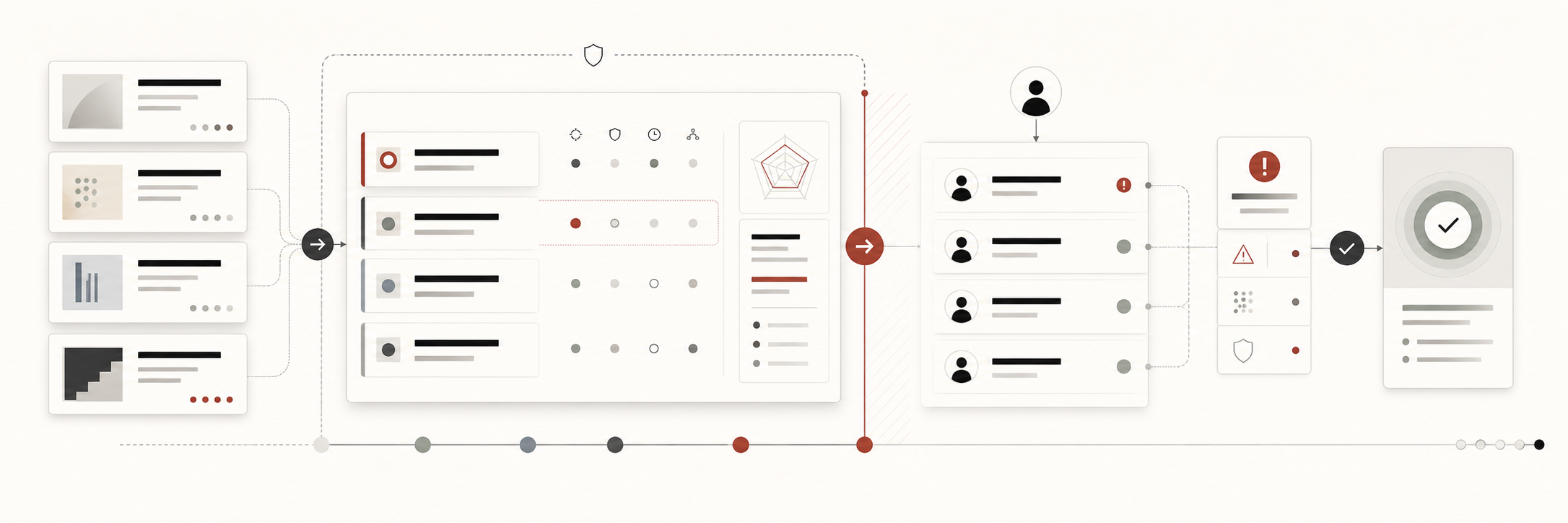
Every AI-native product team eventually meets the same fork in the road: the model can clearly do more, but doing more would quietly move accountability away from the person who owns the consequence.
That fork is where the real design work begins. Not in the demo, not in the model picker, not in the polished concept deck. The real work is deciding which parts of the workflow can be accelerated by AI, which parts need expert review, and which parts should never be owned by a probabilistic system at all.
In healthcare, this becomes concrete very quickly. An AI can draft a SOAP note, extract diagnoses from a conversation, summarize a patient history, and suggest what a provider may need before the next visit. Those are useful capabilities. The risk begins when the interface makes those suggestions feel more final than they are.
The rule I design against
The clearest rule I have found is simple enough to use in product reviews:
- AI proposes. It drafts, extracts, summarizes, compares, and recommends.
- Experts decide. Clinicians, designers, researchers, PMs, engineers, and leaders review, correct, approve, or reject.
- Systems own facts. Deterministic services preserve state, identity, permissions, audit history, and committed records.
The value of the rule is not that it sounds clean. The value is that it forces the team to make product boundaries explicit. If AI writes a draft note, what state is it in? If a provider edits it, what changed? If the note is signed, what exactly became part of the record? If the model suggested a billing code, where did that suggestion come from, and who accepted it?
Human-in-the-loop is not a checkbox. It is a promise that the human's job is genuinely easy to do well.
The interface has to protect the decision
The phrase "human-in-the-loop" gets used as if the loop itself creates safety. It does not. A tired clinician staring at a dense wall of generated text is technically in the loop. That does not mean the product has helped them make a good decision.
The interface has to make the review path obvious, fast, and accountable. That means provenance is visible where the claim appears. Draft state is visually distinct from approved state. Corrections are easier than rewrites. Rejection is a first-class action, not an awkward workaround. The source behind a recommendation is close enough that the reviewer can inspect it without losing flow.
If review is harder than approval, people approve. If the source is hidden, people either over-trust or stop trusting entirely. Both failure modes are design failures.
What AI should be allowed to do
AI is strongest when it reduces the cost of getting to a better first draft or a clearer next question. I want it summarizing visit context, grouping related signals, preparing review surfaces, comparing requirements, detecting missing states, and helping teams see what they would otherwise miss.
I do not want it quietly becoming the system of record. I do not want it owning permissions, final identity, irreversible workflow state, clinical commitment, or audit history. Those responsibilities belong to deterministic systems and accountable humans.
That distinction makes AI more useful, not less. A constrained model role is easier for users to understand. A clear approval state is easier to trust. A product that says "this is a draft" and means it is more credible than one that buries uncertainty behind polish.
A practical design checklist
- Label generated work as draft until a person approves it.
- Show provenance at the point of use, not in a hidden drawer.
- Separate "reviewed" from "accepted" and "accepted" from "committed."
- Make correction and rejection low-friction.
- Use deterministic systems for identity, permissions, and audit state.
- Design for the busiest credible user, not the ideal reviewer in a quiet room.
The last point matters. If the workflow only works when a user has unlimited time and perfect attention, it does not work. High-stakes product design has to respect the conditions under which the product will actually be used.
Why this matters beyond healthcare
Healthcare makes the stakes visible, but the same pattern appears in finance, insurance, education, legal workflows, enterprise operations, and internal product development. Anywhere AI produces a plausible recommendation, a team has to decide whether that recommendation is a draft, a decision, or a committed fact.
Those are different things. Good AI-native design makes the difference visible.
That is the design leadership challenge now. Not proving that AI can generate an answer. Proving that the product can help a person decide what to do with it.
FAQ
When should AI propose in a product workflow?
AI should propose when the work benefits from drafting, summarization, extraction, comparison, or recommendation, and when a qualified human can review the output before it becomes authoritative.
When must a human decide?
A human must decide when the output affects accountability, safety, clinical or legal records, business commitments, or irreversible product state.
What does systems own facts mean?
It means deterministic systems should own identity, permissions, committed records, audit history, and workflow state. A model can help prepare information, but it should not be the source of truth.
What makes human-in-the-loop AI trustworthy?
The loop works when review is easy to perform well: visible provenance, clear states, fast correction, low-friction rejection, and explicit approval before commitment.
What is the biggest UX mistake in AI review workflows?
The biggest mistake is making generated output look finished before it has been reviewed. Polish can create false confidence when the evidence and state are unclear.