
The art of cross-functional collaboration
Cross-functional collaboration works when teams share context, not when everyone pretends to have the same job.
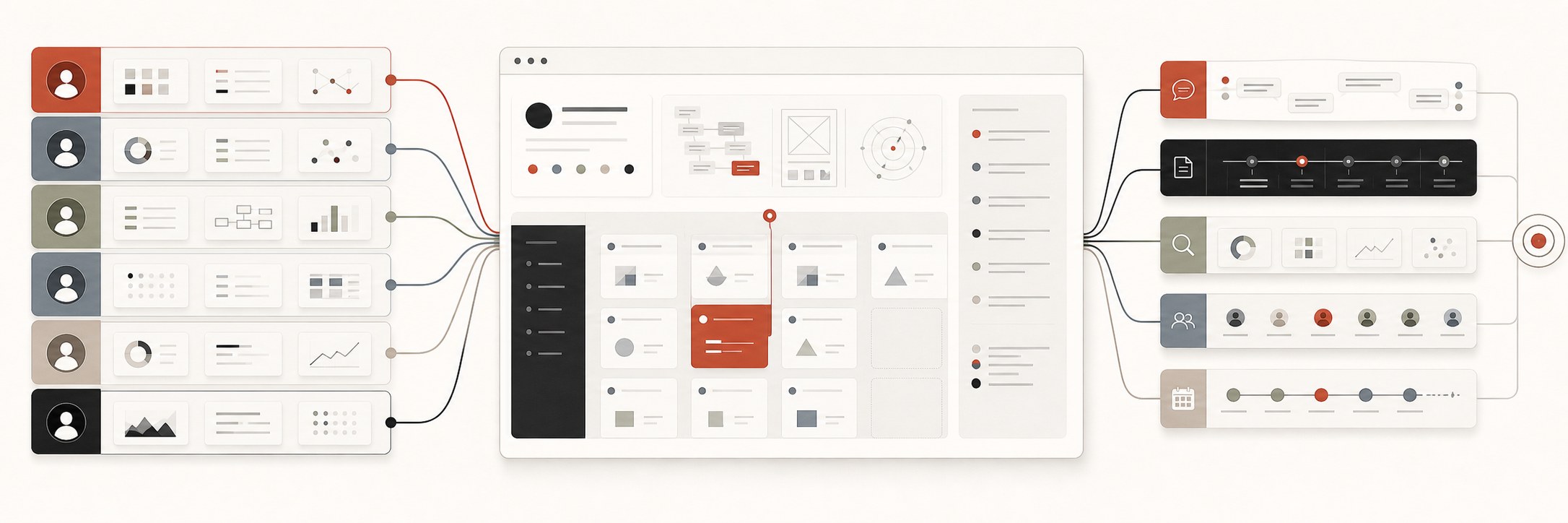
How design, product, engineering, research, marketing, and leadership converge around shared goals without flattening their expertise.
Respect the lenses
Design, product, engineering, research, marketing, and leadership each see different risks. Collaboration improves when those lenses stay distinct and visible.
Create shared goals
Teams need a common definition of success. Shared goals turn competing opinions into tradeoffs the team can evaluate together.
Make communication explicit
Clear channels, decision logs, critique rituals, and working agreements reduce hidden churn. The more complex the product, the more important visible communication becomes.
Use conflict productively
Disagreement is useful when it exposes risk, assumptions, or missing evidence. The goal is not consensus at all costs; it is better product judgment.
- Start with evidence before choosing a solution.
- Make the decision model visible to product, design, engineering, and leadership.
- Connect craft to measurable user and business outcomes.
FAQ
What is cross-functional collaboration?
It is the coordinated work of multiple disciplines, such as design, product, engineering, research, and leadership, toward a shared product goal.
How do you improve cross-functional collaboration?
Clarify goals, roles, communication channels, decision rights, evidence standards, and review rituals.
Why does cross-functional collaboration fail?
It fails when teams lack shared context, hide decisions, collapse roles, or treat disagreement as a problem instead of a source of risk awareness.

Jay Trainer
Design Leader
Design executive focused on AI-native healthcare workflows, UX research, product design leadership, design systems, and human-in-the-loop product development.