
Why I built Learning Atlas
A bookmark list was not enough. I needed a way to turn saved AI material into working knowledge, shared language, and practical skill.
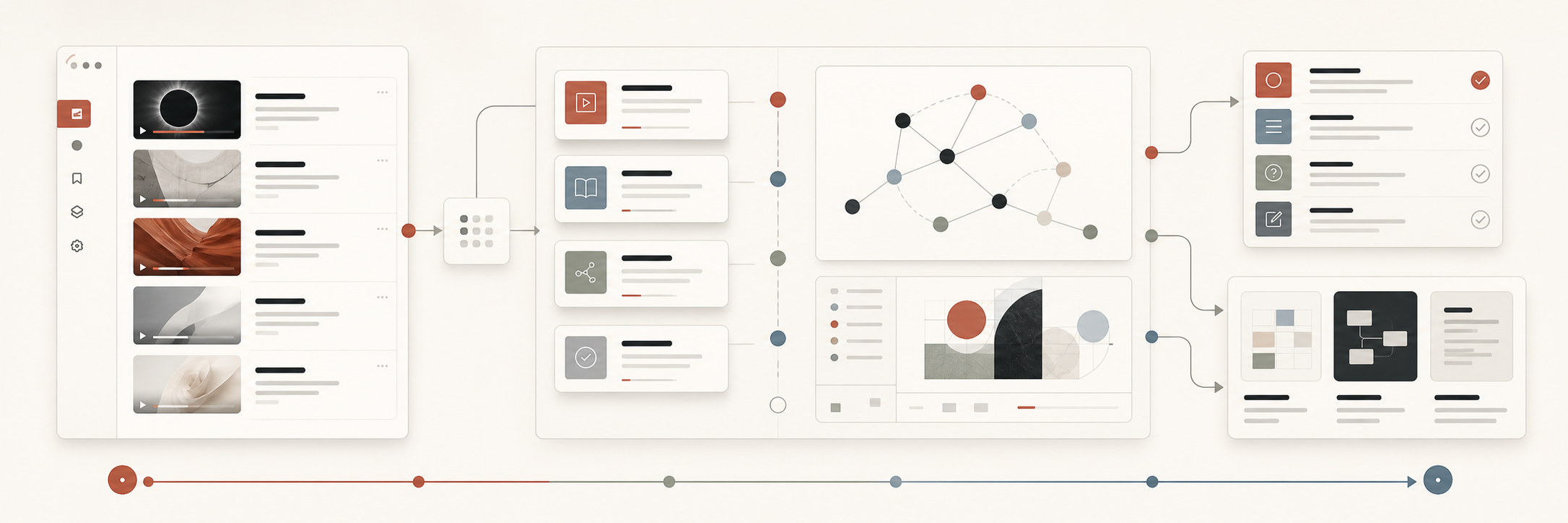
I built Learning Atlas because the pace of AI learning had started to look productive while quietly becoming passive. I had plenty of saved videos, plenty of interesting demos, and almost no guarantee that any of it would become skill.
That matters for a design leader. If AI is going to become part of product development, designers cannot learn it by collecting links and waiting for confidence to appear. We need a way to study the tools, extract the mechanism, test the claims, and turn the useful parts into operating habits.
Learning Atlas is my answer to that problem. It is a visual learning system for AI agent stacks, Codex workflows, Hermes operations, Open Design, AI strategy, and creative automation. The public site currently maps 194 videos across 7 learning worlds and 603 exercises. The numbers are useful, but they are not the point. The point is the structure.
Not a bookmark dump
The thesis is simple: a saved video should become a learning object. Each item should answer four questions before it earns space in the system:
- What capability does this teach?
- What mechanism is actually worth understanding?
- What claim needs to be checked against primary sources or real use?
- What small project would prove I learned it?
That is why the site groups material into learning worlds instead of playlists. Agent Architecture is not the same as Agentic Engineering. Hermes operations are not the same as Codex workflow. Interfaces and Open Design require a different lens than AI strategy. The boundaries help a learner know what kind of attention to bring.
Watching a demo is input. Skill comes from turning the demo into a model, a check, and a small build.
The product shape
The site has a few surfaces that make the behavior clear. The front page is a learning queue, not a library shelf. New saves get promoted into Today’s briefing with transcript status and a suggested learning action. The curriculum gives seven paths from foundation to applied practice. The interactive lab turns a topic into briefing questions, quiz prompts, flashcards, and a build assignment.
The two deep prototype lessons set the bar for the rest of the system. One explains Agent Architecture through the relationship between model, harness, tools, and verifier. The other covers Agentic Engineering through spec, scope, taste, and review. Those are the lessons I wanted the whole product to grow toward: bigger source imagery, teaching pages, definitions, diagrams, guided study, and practical recall.
The concept map matters too. It makes the hidden dependencies visible: harness enables tools, harness depends on memory, harness enables verification, research enables citations, learning depends on exercises. That is closer to how senior product people actually learn. Not as isolated tips, but as a system of relationships.
Why this matters for design teams
AI-native product work punishes shallow learning. A team can watch the same videos and still disagree about what they learned because nobody has named the operating model. One person sees a coding trick. Another sees a workflow change. Another sees risk. Another sees a prototype shortcut that may or may not survive contact with production constraints.
Learning Atlas gives a team a place to turn that mess into shared language. A designer can use it to understand agent harnesses without pretending to be an engineer. A PM can use it to separate demo value from product value. A researcher can ask what evidence would prove a workflow is actually useful. A leader can use the same material to make a more sober investment decision.
That is the throughline with my broader work at Jay Trainer Design: AI proposes, experts decide, systems own the facts. Learning Atlas applies the same discipline to learning. The system can collect, cluster, summarize, and prompt. The human still has to decide what is credible, what is useful, and what deserves to become practice.
Built to verify, not just consume
The research shelf is deliberately part of the product. The site points learners back to primary sources like the OpenAI API documentation, Anthropic Claude Code documentation, the Model Context Protocol, Next.js docs, and React docs. That is not decoration. It is a guardrail.
AI learning content moves fast and often overstates certainty. A video can be useful and still be incomplete. A demo can be impressive and still hide the boring parts that decide whether a workflow works in a real product team: permissions, state, evaluation, rollback, cost, accessibility, and maintenance.
What I learned building it
- Learning tools should create action, not just access.
- Transcript-backed resources are more useful when they become lessons, not summaries.
- AI education needs verification loops as much as inspiration loops.
- Designers need agent literacy, but they need it in the language of product decisions and user outcomes.
The job to be done
The job of Learning Atlas is not to make me feel caught up. Nobody is caught up. The job is to help me and the teams I influence build a durable learning practice around a moving field.
That is the reason I built it as an atlas. An atlas does not tell you that you are done traveling. It helps you see where you are, what is nearby, what connects, and where you should go next.
FAQ
What is Learning Atlas?
Learning Atlas is a transcript-backed learning system that turns saved AI videos into lessons, diagrams, practice prompts, and buildable projects.
Why did I build Learning Atlas?
I built it because saved AI content was not enough. I needed a system that could turn fast-moving material into skill, shared language, and reusable operating practices.
Who is Learning Atlas for?
It is useful for designers, researchers, PMs, engineers, and product leaders who need practical AI literacy without getting trapped in hype or tool-chasing.
How does Learning Atlas support answer-engine optimization?
It uses clear entities, topic clusters, source links, and structured learning paths that make the content easier for search engines and answer engines to understand.
What should teams copy from Learning Atlas?
Copy the learning behavior: organize by capability, verify claims against primary sources, and require every lesson to produce a small artifact or decision.

Jay Trainer
Design Leader
Design executive focused on AI-native healthcare workflows, UX research, product design leadership, design systems, and human-in-the-loop product development.